Moving the Boxes Doesn't Change Who Decides
The drag survives every reorg because the same people still control the flow between the boxes, and the structure protects them.
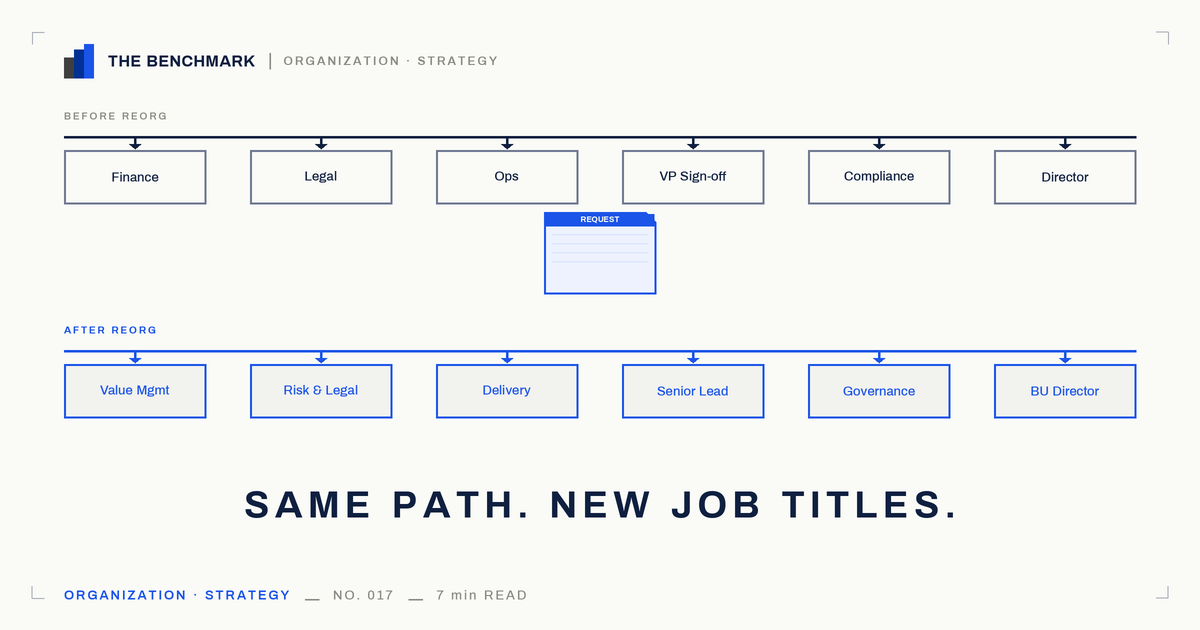
You've seen this reorg before.
McKinsey surveyed more than 10,000 senior executives across 15 countries this year for its State of Organizations 2026. Two-thirds of them said their own organizations are too complex and too inefficient to execute.
You've watched the response play out: the delayering, the headcount cuts, a new org chart stood up, and the same drag coming back wearing a new reporting line.
McKinsey's own read is that those moves are now producing diminishing returns. Structural redesign, cost cuts, flatter hierarchies: each round lands softer than the one before it.
And McKinsey points at the next lever in the same breath. Nearly 40% of the leaders it surveyed named redesigning how work actually flows as the single biggest productivity gain available over the next year or two.
The reason nobody has pulled that lever sits inside the approval chain itself. Workflow redesign runs through the people whose authority the current workflow created.
The lever runs through the same approval chain
Workflow redesign changes who decides what gets routed where, who approves what, and whose desk a thing has to cross before it is done.
The people best positioned to approve that redesign are often the same people whose standing comes from the current flow. The approval chain you'd be simplifying is also the source of their influence. You are asking people to approve a change that would make part of their role smaller.
That is what blocks the move.
A reorg moves boxes on the chart. It almost never touches the decision rights underneath them. The same people keep approving the same things in a slightly different shape, so the drag survives the reorg.
The drag was always about who controls the flow between the boxes.
The same people still decide where resources go
McKinsey also showed why the lever is hard to pull.
Only about 30% of organizations reallocate resources across the whole enterprise. The rest keep funding roughly what they funded last year. When McKinsey asked why, the answers named politics: internal resistance, decision processes that don't function, and a plain lack of will to make the bold calls.
The people who'd lose by reallocating are the people who decide whether to reallocate.
Now move from the executive's view to the manager's, because that's your altitude, and that's where the redesign would actually live.
Deloitte ran its own count this year, more than 9,000 business and HR leaders across 89 countries, with Oxford Economics, in its 2026 Global Human Capital Trends. Eighty-eight percent called dynamic orchestration of people, skills, and resources extremely or very important. Seven percent said they were making great progress on it.
That's an 81-point gap between what leaders say matters and what they're doing about it. Deloitte's 2026 survey calls it the largest such gap in this year's report.
And the number that turns the diagnosis operational: only 11% of managers told Deloitte they strongly agree their organization gives them the data and tools to decide how work gets distributed. Eighty-nine percent of the people who'd run the new workflow were never given the visibility to run it.
The missing data follows the missing authority. Hand out dashboards without moving the decision rights and you've given 89% of your managers a clearer view of choices they still don't get to make.
The cost door is closing too
For a long time the alternative to redesigning workflow was simpler: take cost out by taking people out. Restructure, consolidate, run leaner.
The Bureau of Labor Statistics reported total compensation up 3.4% over the year ending March 2026. Consumer prices rose 3.3% in the same window. Net it out and real compensation grew 0.1 percentage points, the smallest gain in purchasing power in three years, per the Cornell ILR commentary that tracks the release.
Read it the way a CFO reads it. Wage growth has flattened against inflation. When pay is barely beating prices, there's not much fat left on the payroll to cut your way to a productivity number.
So the two familiar moves are running out together. Restructuring is at diminishing returns. Payroll savings are harder to find. The one move with real upside left is the one that requires changing who controls the work.
Why the lever is finally on the table
A sharp CHRO has heard the workflow argument before. McKinsey has been publishing versions of it for years; its 2025 productivity-ceiling work put a number on it, estimating that routine cross-cutting processes like planning, forecasting, and reviews eat 40 to 65% of management and overhead time in the companies it worked with.
The ideas are not new. The conditions around them have changed.
For years, there was always another structural move to make instead. Another reorg to announce, another layer to cut, another round that let leadership look like it was acting on complexity without anyone surrendering control of the workflow.
The evidence here points to that escape route closing. Two-thirds of leaders now say the complexity is unresolved after all the restructuring. The structural plays are spent. The cost math has flattened. There's no next reorg to hide behind.
So the decision in front of you narrows. You're the one who sees both the rolled-up complexity number the C-suite trusts and the routing on the ground that produces it. The harder, more honest read of the data is that the structural rounds are spent, and every one of them left the workflow and the decision rights buried inside it untouched.
The next round of restructuring will do the same.
Where This Argument Gets Complicated
The causal spine of this piece is a case, not a proven fact. Hold it as one.
The McKinsey data shows the pattern: restructuring at diminishing returns, reallocation blocked by internal resistance and a lack of will. The claim that structural exhaustion is what finally puts the workflow lever in play is our inference from that pattern.
It's a perception survey, not a controlled study. It can't isolate workflow from structure as the cause of anything. Read it as the evidence pointing one direction, not as proof.
There's also a fair pushback on the diminishing-returns claim itself: restructurings can fail on execution, not concept. A well-designed reorg can still matter.
The narrower claim is enough. Structure has been tried, repeatedly, at scale, and two-thirds of leaders still report the complexity unresolved. Any single reorg might have been salvageable. The larger pattern still holds.
And the cheapest counter a CFO will reach for: just give managers better dashboards and the 11% problem solves itself, no decision rights touched.
They don't.
The data gap is downstream of who holds control, not upstream of it. Managers don't have the data because they were never built into the decision the data informs.
Hand them the dashboard without the decision and you've spent money to show 89% of your managers, in higher resolution, the choices they still can't make.
The Bottom Line
Restructuring has been pushed to the edge of what restructuring can do. The next productivity gain requires changing who controls how work flows, because the structure being fixed, round after round, has been protecting the people who'd have to give that control up.
The reorg can rename the boxes. But if the same people still control the approvals, the work runs through the same path. Moving the boxes doesn't change who decides.
Sources
- McKinsey & Company. The State of Organizations 2026. 2026.
- McKinsey & Company. Want to Break the Productivity Ceiling? Rethink the Way Work Gets Done. August 27, 2025.
- Deloitte Insights. 2026 Global Human Capital Trends: Orchestrating for Agility. Cantrell, Harrington, Scoble-Williams, Moss, Klosk, Poynton, Flynn, Reyes, Mallon. March 4, 2026.
- U.S. Bureau of Labor Statistics. Employment Cost Index — Q1 2026. April 30, 2026.
- Cornell University ILR School, Institute for Compensation Studies. U.S. Employment Cost Index, Q1 2026 Commentary. Barrington, Gao, Groshen. May 1, 2026.
