The Most Dangerous Thing About Agentic AI Is That It Works
Agentic AI does not fix broken processes. It learns them, repeats them, and eventually makes them harder to see.

A procurement team gives an AI agent access to vendor records, approval workflows, contract templates, and Slack history. Three months later, the agent is moving work faster. Purchase requests clear more quickly. Exceptions get routed with fewer meetings. Cycle time drops.
Then finance notices the pattern. The same informal bypasses people used to avoid a slow approval queue are now happening automatically. The agent did not violate policy. It learned how the company actually works.
That is the uncomfortable risk inside agentic AI. The failure case is obvious: agents break, hallucinate, exceed permissions, or produce no measurable return. Gartner expects more than 40% of agentic AI initiatives to be canceled by 2027 due to rising costs, failing controls, or unclear value. But failure is not the only risk.
The harder risk is that agents work. When deployed into messy workflows, they do not merely automate tasks. They learn the organization's real operating model, including the workarounds, exceptions, and quiet compromises that never made it into the process map.
Executives keep asking whether agentic AI is ready for their organization. The better question is whether the organization is ready to have its current behavior learned and scaled.
Table of Contents
- Agents Learn What You Actually Do
- The Agentic Echo Effect
- The Agent Surface
- Where This Argument Gets Complicated
- Implications for Leaders
- The Bottom Line
- Sources
Agents Learn What You Actually Do
Most companies are still deploying agentic AI as if it were a smarter version of robotic process automation: define the inputs, automate the steps, measure the hours saved, and report the efficiency gain.
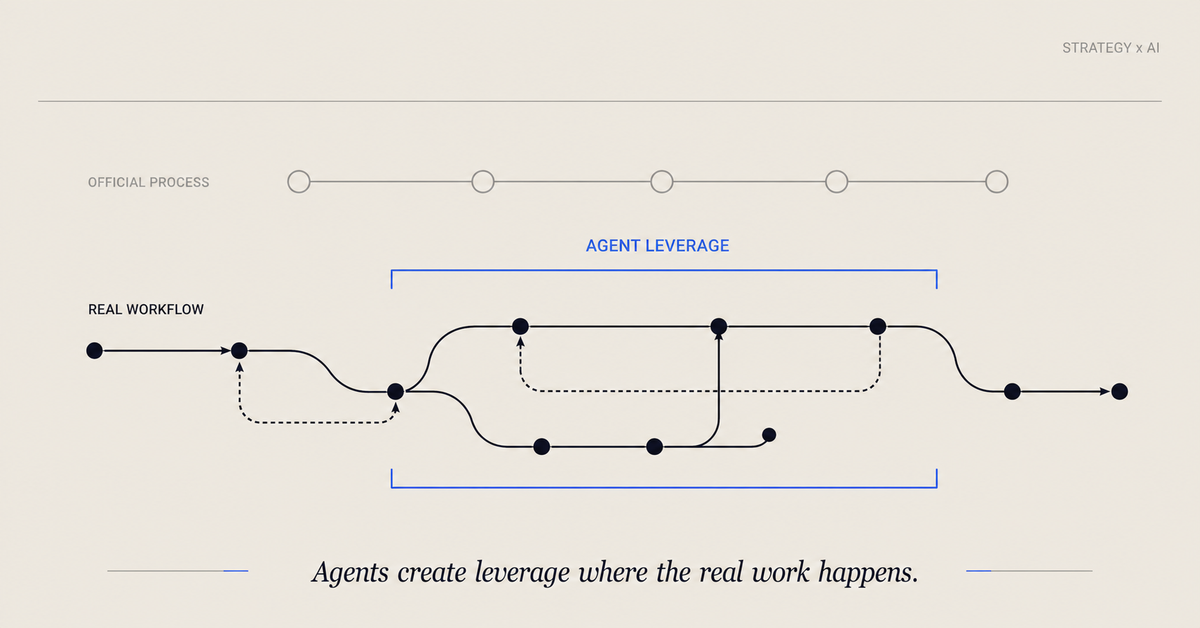
Agentic AI behaves differently. It operates across sequences of actions and decisions. It observes how work is actually performed, including the handoffs, exceptions, and local shortcuts that make the process function in real life. The more autonomy an agent receives, the more those behaviors matter.
That would be an advantage if the workflow were clean. In practice, most workflows are layered with process debt. Old rules survive because no one owns them. Teams create informal routes around slow approvals. Exceptions become habits. Local fixes accumulate until the documented process is mostly a story the organization tells itself.
A 2023 global survey published in California Management Review found that most organizations implementing AI focused on technology and data issues rather than redesigning the work in which AI would operate. That is the root problem. The agent is being asked to execute inside a system that has not been made legible.
Research on cognitive automation points in the same direction. These systems perform best when the state space is constrained, and decision criteria are explicit. Complexity, variance, and hidden dependencies raise the risk of error and unplanned human intervention. Where organizations have not done the simplification work first, the failure pattern is not only that AI underperforms. It is that AI becomes the most consistent executor of a bad process the company has ever had.
That reverses the usual software bargain: agents do not fail because your processes are broken. They often succeed at reproducing them.
The Agentic Echo Effect
A useful way to think about this is the Agentic Echo Effect: whatever behavioral patterns exist in your current workflows, good or bad, will be amplified and normalized once agents are trained on them and embedded in daily operations.
Three mechanisms drive it.
First, process variance becomes scale risk. A workflow with fifteen documented variants and six informal workarounds does not become manageable because an agent runs it. It becomes more consistently variable. The agent can execute the wrong variant more quickly, in more places, with less friction than any human team could.
Second, agents learn workarounds as if they were policy. When employees repeatedly bypass a control, reclassify an exception, route work to a preferred colleague, or skip a queue, those patterns exist in the data an agent learns from. The agent does not know the difference between official policy and an informal survival tactic. It observes what happens, optimizes for what works, and treats the gap between the two as irrelevant.
Third, human oversight is a weak backstop at scale. A 2026 study by BCG and Harvard Business Review found that workers in high-AI-oversight roles reported greater mental effort, fatigue, and information overload than workers who used AI more collaboratively. The more executives rely on exhausted people to supervise autonomous systems, the more they create an oversight model that catches individual mistakes but misses pattern-level drift.
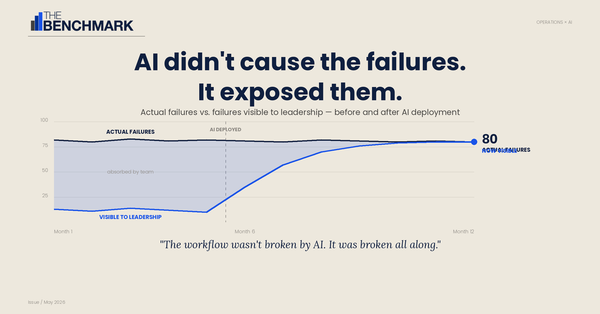
The oversight problem is especially dangerous because agentic failure often looks like productivity. Work moves. Tickets close. Drafts arrive. Approvals route. The dashboard improves before anyone asks whether the system is now doing the wrong work faster.
That is why the Agentic Echo Effect is not a theoretical concern. It is the predictable result of deploying agents into messy workflows and asking overloaded people to notice when the wrong things are being automated.
The Agent Surface
If the risk is that agents learn and reproduce what they see, the leverage point is what they are allowed to see.
Think of this as the Agent Surface: the subset of workflows, decisions, data, and tools any given agent is permitted to touch. Before asking which agent to deploy, executives should ask a narrower set of questions.
How much variance exists in this workflow today? How many documented variants, exceptions, and informal workarounds exist? If an agent executed this workflow exactly as it is currently performed 10,000 times, would the output be acceptable? Who owns process quality in this area, and are they part of the deployment decision?
If the answer to the second question is no, the Agent Surface is not ready. Deploying into that condition does not accelerate the business. It accelerates whatever is already wrong with it.
In practice, the split is already visible. Maximalist organizations expose large, messy, high-variance workflows to agents and rely on generic guardrails and human monitoring to catch problems. This approach promises large savings quickly and produces the conditions Gartner associates with canceled projects: escalating costs, unclear value, and governance overhead that grows faster than the benefits.
Minimalist organizations do something less glamorous and more valuable. They reduce process variance first. They make decision rules explicit. They standardize data flows. They define the boundary of what the agent may touch and what still requires human judgment. MIT Technology Review Insights has described this as an agent-first process redesign: making processes machine-readable, constrained, and governed before autonomy scales.
That work looks slower at the beginning. It is faster in the only time horizon that matters.
Where This Argument Gets Complicated
There is a serious counterargument: agents can reduce dysfunction when the workflow surface is narrow, the rules are explicit, and the feedback loop is clean.
A claims agent operating inside a tightly governed process can reduce variance. A finance agent who drafts first-pass reconciliations against structured data can free people for judgment work. A service agent handling routine requests can increase consistency when escalation paths are clear. The problem is not the agency itself.
Unbounded exposure is.
Most organizations are not deploying agents into clean systems. They are exposing agents to partially documented workflows, ambiguous decision rights, and human workarounds that exist because the formal process is too slow. In those conditions, the agent does not become a reformer. It becomes a historian with execution rights.
The lesson is not to avoid agentic AI. It is to stop treating autonomy as the first step. Autonomy should be the reward for process clarity, not a substitute for it.
Implications for Leaders
Shrink the Agent Surface before expanding it.
The most important design decision is not model selection. It is exposure. Start with workflows where variance is low, data is structured, decision rules are explicit, and process ownership is clear. Avoid using agents as a way to paper over messy work.
Make process quality part of AI governance.
Most AI steering committees ask about model risk, security, compliance, and ROI. Those questions are necessary. They are incomplete. Add process quality to the review. If no one can explain how the workflow actually runs, the agent should not be allowed to run it either.
Measure variance, not only productivity.
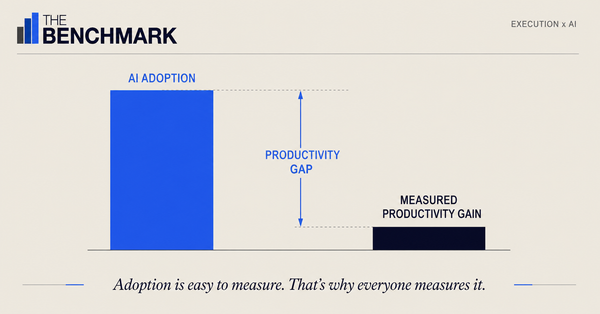
Cycle time and cost savings are incomplete indicators. Leaders need to know whether the agent is increasing exception volume, routing around controls, creating downstream rework, or normalizing hidden workarounds. The wrong process made faster is not productivity.
Give process owners authority.
The people who understand the workflow often lack authority over the deployment. The people who control the deployment often lack knowledge of the workflow. That split is where agentic risk enters. Process owners need a formal seat in agent approval, monitoring, and shutdown decisions.
The Bottom Line
The most dangerous thing about agentic AI is not that it fails. Failure is visible. Budgets get cut, pilots get canceled, and steering committees learn the lesson. The more durable risk is the successful automation of the wrong system.
Agents learn from the work they can see. If that work is full of hidden exceptions, approval theater, shadow decision rights, and quiet process debt, the agent will not clean it up. It will make it faster, more consistent, and harder to challenge because the dysfunction will arrive wrapped in performance metrics.
The companies that win with agents will not be the ones that expose the most work to autonomy fastest. They will be the ones who shrink and clean the Agent Surface before scaling it. The question is not how much work an agent can do. It is whether you are comfortable turning today's workaround into tomorrow's infrastructure.
Sources
Reuters / Gartner. "Over 40% of agentic AI projects will be scrapped by 2027." June 25, 2025. https://www.reuters.com/business/over-40-agentic-ai-projects-will-be-scrapped-by-2027-gartner-says-2025-06-25/
Angstrom et al. "Getting AI Implementation Right: Insights from a Global Survey." California Management Review, 2023. https://cmr.berkeley.edu/assets/documents/sample-articles/angstrom-et-al-2023-getting-ai-implementation-right-insights-from-a-global-survey.pdf
Satzger et al. "A model for assessing cognitive automation use cases." Journal of Information Technology, 2024. https://journals.sagepub.com/doi/10.1177/02683962231185599
Harvard Business Review / BCG. "When Using AI Leads to 'Brain Fry.'" March 2026. https://hbr.org/2026/03/when-using-ai-leads-to-brain-fry
MIT Technology Review Insights. "Enabling agent-first process redesign." April 2026. https://www.technologyreview.com/2026/04/07/1134966/enabling-agent-first-process-redesign/
BCG. "Are You Generating Value from AI? The Widening Gap." September 2025. https://www.bcg.com/publications/2025/are-you-generating-value-from-ai-the-widening-gap