Remote Work Didn't Kill Productivity
Remote work preserved output. It weakened the networks that create new ideas.

The productivity argument over remote work is mostly over. Hybrid work did not collapse output. In some settings, it improved retention without damaging performance. The companies still arguing only about productivity are fighting the wrong battle.
The harder question is what happens to innovation.
Innovation depends on weak ties, tacit knowledge transfer, and unplanned collisions between people who do not already work together. These are not cultural ornaments. They are part of the organization's idea infrastructure. Remote and hybrid work can preserve the execution of known work while weakening the networks that generate new work.
That is the risk hidden in the data. Remote work did not kill productivity. It may be creating innovation debt: a slow accumulation of missed collisions, thinner informal networks, and knowledge that fails to move before the people who hold it leave.
Table of Contents
- Productivity Was the Wrong Fight
- The Weak Tie Problem
- Tacit Knowledge Has Fewer Places To Go
- Coordination Overhead Is Not Neutral
- Where This Argument Gets Complicated
- Implications for Leaders
- The Bottom Line
- Sources
Productivity Was the Wrong Fight
Stanford SIEPR research shows that work from home has stabilized as a durable part of the U.S. labor market. Return-to-office mandates make headlines, but they do not appear to be reversing the overall pattern at scale. Hybrid work is now part of the operating model for a large share of remote-capable roles.
The best evidence also shows why the productivity debate became too blunt. The large randomized trial at Trip.com found no meaningful productivity penalty from hybrid work and improved retention. Other studies have found similar nuance: the productivity effects depend on role type, management quality, coordination needs, and worker preference.
That should have ended the simplistic argument that remote work is inherently unserious. It did not.
But there is an equal mistake on the other side. Because output did not collapse, many leaders concluded that the model had no strategic cost. That conclusion is too narrow. Productivity measures the completion of known work. Innovation depends on the creation, movement, and recombination of knowledge.
Those are different systems.
A remote team can deliver the roadmap and still weaken the network that would have generated the next roadmap. A hybrid company can protect task completion while losing the weak ties that surface problems early. A distributed workforce can maintain meeting velocity while reducing the accidental exposure through which ideas travel.
The risk is not visible in the weekly output. It appears later, when the company wonders why fewer new ideas are arriving.
The Weak Tie Problem
Weak ties are the relationships that connect people across functions, teams, levels, and knowledge domains. They are not close working relationships. They are the casual connections that expose employees to information they would not otherwise encounter.
Mark Granovetter's foundational work on the strength of weak ties showed why these connections matter. Strong ties often share the same information. Weak ties bridge different knowledge clusters. They carry new ideas, early warnings, and unexpected combinations.
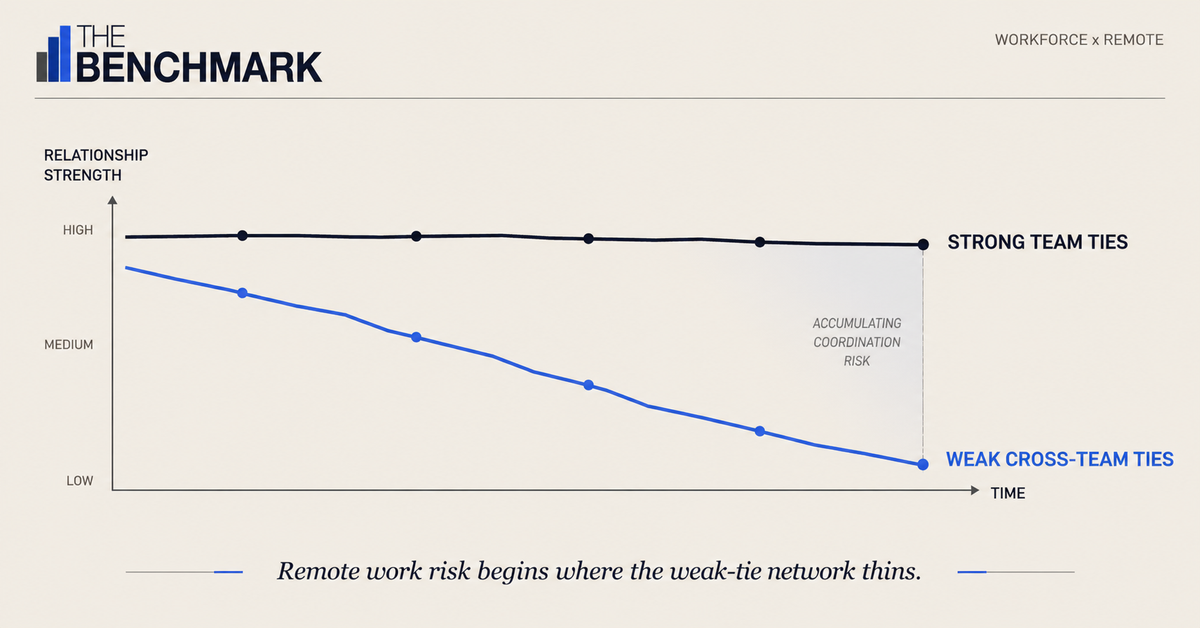
Remote work tends to preserve strong ties. Teams that already work together keep working together. Recurring meetings continue. Project channels remain active. The core execution loop survives.
The weaker ties are more fragile.
Research from Microsoft, MIT, and UC Berkeley on more than 60,000 Microsoft employees found that firm-wide remote work made collaboration networks more static and siloed. Employees communicated more within existing groups and less across groups. The network became more efficient at preserving existing work and less effective at forming new cross-boundary connections.
That is where the innovation problem starts. New ideas rarely emerge from the same people talking to the same people about the same work. They emerge when knowledge crosses boundaries.
Remote work does not eliminate that possibility. It makes it less automatic.
Tacit Knowledge Has Fewer Places To Go
Innovation also depends on tacit knowledge: the judgment, intuition, context, and pattern recognition that experienced people carry but cannot fully document.
Tacit knowledge moves through observation, apprenticeship, and repeated exposure to how experts think. It is transferred in the moment when a senior employee explains why a customer objection matters, why a metric is misleading, or why an exception is not actually an exception. Some of this can happen remotely. Less of it happens by default.
The problem is most visible when experienced employees leave. Organizations often discover too late that what mattered was not in the documentation. It was in how the person interpreted edge cases, navigated informal networks, and knew which details were signals rather than noise.
Hybrid and remote work can make this worse when junior employees receive fewer informal learning opportunities. They may attend the scheduled meetings but miss the surrounding context: the pre-meeting interpretation, the hallway debrief, the quick correction, the observational learning that turns procedure into judgment.
This is not nostalgia for the office. Offices can be terrible learning environments. Proximity alone does not transfer knowledge. But distributed work requires deliberate design to replace what proximity once provided badly, but often.
Without that design, tacit knowledge becomes local, sticky, and vulnerable. It stays with the people who already have it.
Coordination Overhead Is Not Neutral
Remote work also changes the cost of coordination.
Some coordination improves. Asynchronous writing can clarify thinking. Recorded updates can reduce meeting load. Distributed teams can document decisions more carefully because they cannot rely on everyone hearing the same conversation.
But weak coordination systems become more expensive when work is distributed. Ambiguity that might have been resolved by proximity becomes another meeting, another thread, another unresolved comment. The organization creates more written artifacts, but not necessarily more shared understanding.
This is where innovation debt accumulates. People spend more time coordinating known work and less time encountering unknown work. Cross-functional interaction becomes scheduled and purposeful. That sounds efficient. It is often less generative.
Innovation needs some unplanned surface area. It needs people to overhear problems outside their lane, ask naive questions, notice adjacent work, and make connections that were not part of the agenda.
The distributed organization has to design for that. If it does not, it will optimize known work at the expense of future work.
Where This Argument Gets Complicated
The counterargument is important: office presence does not guarantee innovation.
Many offices are full of people sitting on video calls with colleagues in other locations. Many cultures punish interruption, discourage dissent, and isolate functions even when everyone is physically present. A mandatory return-to-office policy can damage trust, reduce retention, and still fail to rebuild weak ties.
The evidence also does not support one universal answer. Some roles benefit from deep focus and remote flexibility. Some teams are already globally distributed. Some organizations have built excellent remote rituals for knowledge sharing, onboarding, and cross-functional exploration.
The question is not remote versus office. It is whether the operating model deliberately protects the network's innovation requirements.
A company can run hybrid work well. It can also run office work badly. The deciding variable is not location alone. It is network design.
Implications for Leaders
Measure weak ties.
Track cross-functional collaboration, new connection formation, mentoring access, and information flow across teams. If people interact only with the same colleagues every week, the organization becomes more efficient but more brittle at the same time.
Design office time around network value.
If employees come in only to sit on video calls, the office is not doing strategic work. Use in-person time for onboarding, problem discovery, cross-functional reviews, customer interpretation, design critique, and informal learning.
Protect tacit knowledge transfer.
Documenting procedures is not enough. Pair junior employees with experienced practitioners in live work. Create forums where judgment is explained, not just outcomes. Capture the reasoning behind decisions before the people who hold it leave.
Watch innovation metrics separately from productivity metrics.
Output, cycle time, and utilization will not reveal innovation debt. Track idea pipeline quality, cross-functional concept generation, internal mobility of expertise, and the time from problem detection to new solution exploration.
Avoid symbolic return-to-office mandates.
Mandates that do not rebuild weak ties or knowledge transfer are theater. If the company brings people together, the design should be explicit: what network problem is this solving, and how will we know whether it worked?
The Bottom Line
Remote work is not the enemy of productivity. That is why the debate has been so misleading.
The greater risk is that organizations preserve output while thinning the networks that generate new ideas. Weak ties decay quietly. Tacit knowledge stays trapped in experienced employees. Cross-functional collisions become scheduled, purposeful, and less generative. None of that shows up immediately in productivity metrics. It appears later as a thinner idea pipeline, slower internal learning, and fewer surprising combinations.
A blanket return-to-office mandate is too blunt an answer. The work is measurement and design. Leaders need to know where weak ties are thinning, where expertise is not transferring, and where the organization has mistaken efficient execution for future capability. Innovation debt does not announce itself. It compounds until the company starts to wonder why nothing new seems to arrive.
Sources
Stanford SIEPR. "Working from Home in 2025: Five Key Facts." https://siepr.stanford.edu/publications/essay/working-home-2025-five-key-facts
Nature Human Behaviour. "The Effects of Remote Work on Collaboration Among Information Workers." 2021. https://www.nature.com/articles/s41562-021-01196-4
Nature. "Remote Collaboration Fuses Fewer Breakthrough Ideas." 2023. https://www.nature.com/articles/s41586-023-06767-1
BLS Monthly Labor Review. "Hybrid Work Seems to Be Working Out Just Fine." https://www.bls.gov/opub/mlr/2023/beyond-bls/hybrid-work-seems-to-be-working-out-just-fine.htm
Granovetter, Mark. "The Strength of Weak Ties." American Journal of Sociology, 1973. https://www.jstor.org/stable/2776392
Jaffe, Henderson, and Trajtenberg. "Geographic Localization of Knowledge Spillovers as Evidenced by Patent Citations." https://papers.ssrn.com/sol3/papers.cfm?abstract_id=227360
Forbes / Dan Pontefract. "Why Organizations Must Capture Knowledge Before It's Gone." https://www.forbes.com/sites/danpontefract/2025/03/13/why-organizations-must-capture-knowledge-before-its-gone/