The Annual Plan Is a Liability. The Evidence Is Overwhelming.
The annual plan is a snapshot. The organization treats it like a map.

A mid-size logistics company finished its annual plan in October. Twelve weeks of analysis, three rounds of executive alignment, and a board-approved budget. By February, the plan was stale.
A competitor had deployed AI-powered routing. Two large customers had shifted sourcing priorities. Fuel assumptions had moved. The demand signals baked into the second half of the year no longer matched the market the company was operating in.
The plan was not poorly built. That was the problem. It was careful, rigorous, and already out of date.
Annual planning was designed for slower environments, where capital moved in large blocks, information was expensive, and competitive assumptions decayed gradually. That is not the operating environment most companies face in 2026. When reality changes faster than the planning cycle, the issue is not the quality of the strategy. It is Organizational Velocity: the speed at which a company can observe a signal, orient resources, decide, and act.
Table of Contents
- A mid-size logistics company finished its annual p …
- The Plan Is Not the Strategy
- Velocity Is the New Moat
- The Agentic Layer Widens the Gap
- The Budget Cycle Is the Hidden Culprit
- Where This Argument Gets Complicated
- Implications for Leaders
- The Bottom Line
- Sources
The Plan Is Not the Strategy
Annual planning gives organizations something they need: a moment to reconcile ambition, resources, and accountability. It forces choices. It creates a shared operating baseline. It helps boards and executives see the business as a portfolio rather than a collection of local requests.
The trouble starts when the plan becomes more authoritative than the conditions that produced it.
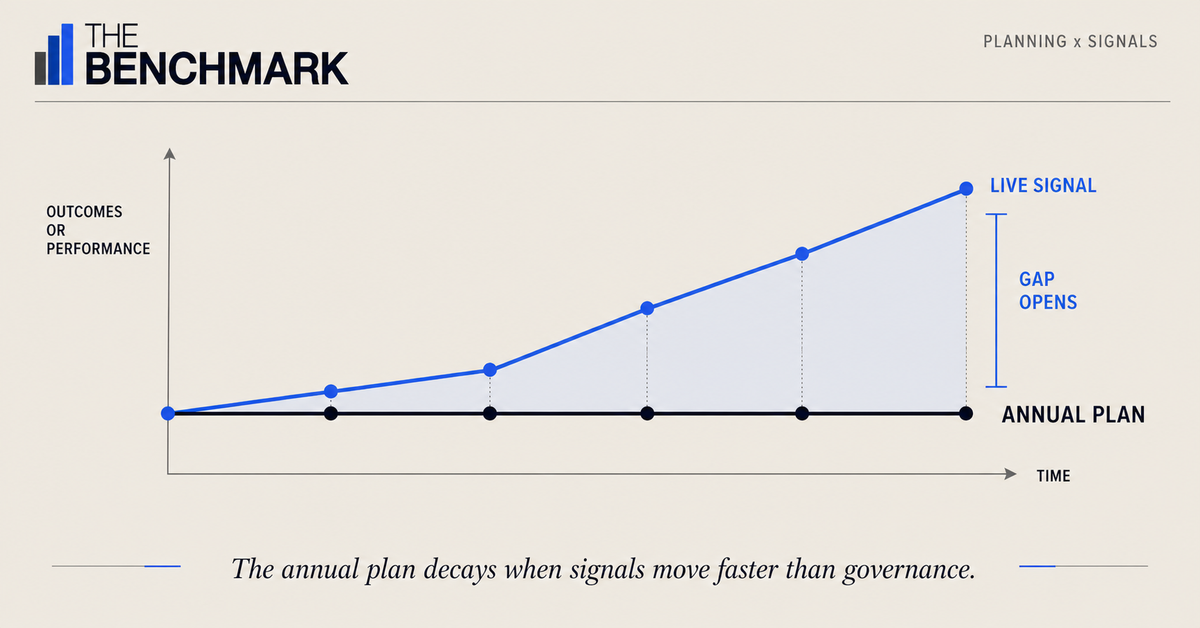
A plan is a snapshot. It captures assumptions at a point in time: demand, pricing, talent availability, technology maturity, competitive behavior, capital cost, and regulatory risk. Some assumptions remain stable. Many do not. The faster they decay, the more dangerous it becomes to manage as if the plan is still describing reality.
This is not a failure of analytical rigor. The most careful plan can still become stale quickly. In dynamic markets, rigor at the beginning of the cycle does not compensate for slow adaptation during the cycle.
The annual plan becomes a liability when it gives the organization permission to stop sensing.
Velocity Is the New Moat
The strategic advantage is moving from planning quality to response quality.
A company still needs a point of view. It still needs capital discipline. It still needs priorities and tradeoffs. But the differentiator is increasingly the cycle time between the external signal and the internal action.
McKinsey's work on technology and operating models points toward this shift: organizations need faster sensing, tighter decision loops, and redesigned operating systems to keep pace with AI and market change. BCG has made a similar argument around continuous planning and business-technology integration. The common theme is not that planning disappears. It is that planning becomes more continuous, more data-informed, and more closely tied to resource movement.
This is Organizational Velocity.
Velocity is not speed for its own sake. It is the ability to move through four steps faster than competitors: observe the signal, orient the organization, decide what changes, and act with resources. Many companies are good at the first step. They have dashboards, customer data, market reports, AI summaries, and executive briefings. Far fewer are good at the last three.
They see the signal. They discuss it. They ask for analysis. They wait for the next planning cycle.
By then, the signal has become someone else's advantage.
The Agentic Layer Widens the Gap
AI makes annual planning more fragile because it changes both the market and the organization simultaneously.
Externally, AI accelerates competitor action. Pricing tests, content generation, product prototyping, customer segmentation, and workflow automation can all move faster than previously expected planning assumptions. A competitor does not need to transform the whole enterprise to create pressure. It only needs to improve one part of the value chain enough to change customer expectations or economics.
Internally, AI accelerates local execution. Teams can produce more analysis, more drafts, more code, more campaigns, and more process outputs. That can be useful. It can also create saturation if decision rights, review capacity, and resource allocation do not move with it.
The annual plan struggles in both directions. It cannot update assumptions quickly enough, nor can it govern the local acceleration AI creates within the organization.
AI strategy, therefore, cannot be separated from planning architecture. A company may adopt AI tools quickly and still move slowly where it matters: shifting capital, redesigning workflows, changing priorities, and stopping work that no longer fits.
The bottleneck is no longer information. It is an organizational response.
The Budget Cycle Is the Hidden Culprit
The annual plan usually fails due to the budget.
Strategy can change in a meeting. Capital does not. Headcount does not. Vendor commitments do not. Incentives do not. The budget is where the plan becomes real, and it is also where old assumptions gain institutional protection.
Once the annual budget closes, existing commitments become the baseline. Any new priority must fight for exceptions, contingency funds, or reallocation. The people defending current commitments have teams, contracts, forecasts, and performance narratives. The new priority has a thesis.
This is why companies can agree that the plan is stale and still keep executing it. The issue is not intellectual agreement. It is a resource permission.
CIO research on continuous planning has shown that top-performing organizations increasingly integrate technology and business planning more tightly and make decisions faster than traditional cycles allow. That is not a finance process detail. It is a strategic infrastructure.
If the budget can only move annually, the strategy can only move rhetorically in between.
Where This Argument Gets Complicated
The counterargument matters: continuous planning can become continuous churn.
Organizations need stability. Teams cannot operate in a constant state of reprioritization. Long-cycle investments require patience. Some strategic bets should not be judged by short-term signal movement. A company that changes direction every month is not agile. It is unmanaged.
This is why the target is not perpetual replanning. It is an explicit planning cadence matched to the decision type.
Some decisions should remain annual. Large capital commitments, long-cycle capability bets, and board-level financial architecture need discipline. Other decisions should be quarterly, monthly, or event-triggered. Customer churn spikes, competitor pricing moves, AI capability shifts, and supply chain disruptions should not wait for the next annual cycle.
The mistake is forcing every decision into the same cadence.
Good planning architecture separates stable commitments from adaptive choices. It protects long-term bets while allowing the organization to update assumptions, move resources, and stop work when evidence changes.
Implications for Leaders
Audit strategy cadence before strategy content.
Before rewriting the plan, ask how often the organization can change a material priority, move capital, or stop work. If the answer is annual, the strategy is constrained before content enters the room.
Separate assumptions from commitments.
Every plan contains both. Commitments define what the organization will do. Assumptions explain why those commitments make sense. Track assumption decay explicitly. When a key assumption changes, the plan should trigger review rather than rely on informal escalation.
Decouple budget envelopes from line items.
Keep financial discipline, but create mechanisms for movement within and across envelopes. A budget that cannot carry over from one cycle to the next turns strategy into a frozen allocation.
Create event-triggered reviews.
Not every review should be calendar-driven. Define the signals that force reassessment: customer churn, competitor moves, AI capability changes, cost shocks, talent constraints, or regulatory shifts. The point is not to constantly review everything. It is to review the right thing when reality changes.
Make stopping work part of planning.
Organizations are better at adding than subtracting. Every planning review should include what stops, shrinks, or loses priority. Without that discipline, continuous planning becomes continuous accumulation.
The Bottom Line
The annual plan is not useless. It is dangerous when treated as the primary instrument of strategy.
A plan captures assumptions at one point in time. In a slow market, that is manageable. In a market shaped by AI, continuous data, supply shocks, and faster competitive response, assumptions decay faster than the governance process that protects them. The organization does not fall behind because its leaders cannot analyze the market. It falls behind because the system is built to defend a snapshot after the world has moved.
The strategic advantage now belongs to organizations with shorter cycles between reality and response. They do not abandon discipline. They redesigned it. The question is no longer whether the annual plan is accurate. It is how quickly the company can stop obeying it when it is not.
Sources
McKinsey & Company. "The State of Organizations." https://www.mckinsey.com/capabilities/people-and-organizational-performance/our-insights/the-state-of-organizations
McKinsey & Company. "McKinsey Global Tech Agenda 2026." https://www.mckinsey.com/capabilities/mckinsey-technology/our-insights/mckinsey-global-tech-agenda-2026
BCG. "The CEO's Guide to Growth in 2026: Seizing Opportunity." January 2026. https://www.bcg.com/publications/2026/the-ceos-guide-to-growth-seizing-opportunity
CIO. "Plan vs. Planning: Why Continuous Planning Must Traverse Time." 2026. https://www.cio.com/article/4134757/plan-vs-planning-why-continuous-planning-must-traverse-time.html
World Economic Forum. "Organizational Transformation in the Age of AI: How Organizations Maximize AI's Potential." 2026. https://reports.weforum.org/docs/WEF_Organizational_Transformation_in_the_Age_of_AI_How_Organizations_Maximize_AI’s_Potential_2026.pdf
Harvard Business Impact. "The AI Frontier: From Exploration to Enduring Transformation." February 2026. https://www.harvardbusiness.org/wp-content/uploads/2026/03/The-AI-Frontier-From-Exploration-to-Enduring-Transformation_Feb2026.pdf
Gartner. "Gartner Predicts Over 40 Percent of Agentic AI Projects Will Be Canceled by End of 2027." June 2025. https://www.gartner.com/en/newsroom/press-releases/2025-06-25-gartner-predicts-over-40-percent-of-agentic-ai-projects-will-be-canceled-by-end-of-2027
Gartner. "Gartner Predicts 40 Percent of Enterprise Apps Will Feature Task-Specific AI Agents by 2026." August 2025. https://www.gartner.com/en/newsroom/press-releases/2025-08-26-gartner-predicts-40-percent-of-enterprise-apps-will-feature-task-specific-ai-agents-by-2026-up-from-less-than-5-percent-in-2025
EY. "Tech Industry Enters a Hyper-Velocity AI Moment, Unlocking New Opportunities for 2026." December 2025. https://www.ey.com/en_nl/newsroom/2025/12/tech-industry-enters-a-hyper-velocity-ai-moment-unlocking-new-opportunities-for-2026
Joget. "AI Agent Adoption in 2026: What the Data Shows." February 2026. https://joget.com/ai-agent-adoption-in-2026-what-the-analysts-data-shows/