The Middle Manager Is Breaking
The management layer is not overhead. It is the translation layer between strategy and behavior.

Three product directors left the same company in eighteen months. Their exit interviews used familiar language: limited growth, an unclear career path, and better opportunities elsewhere.
HR treated it as retention. The pattern was structural.
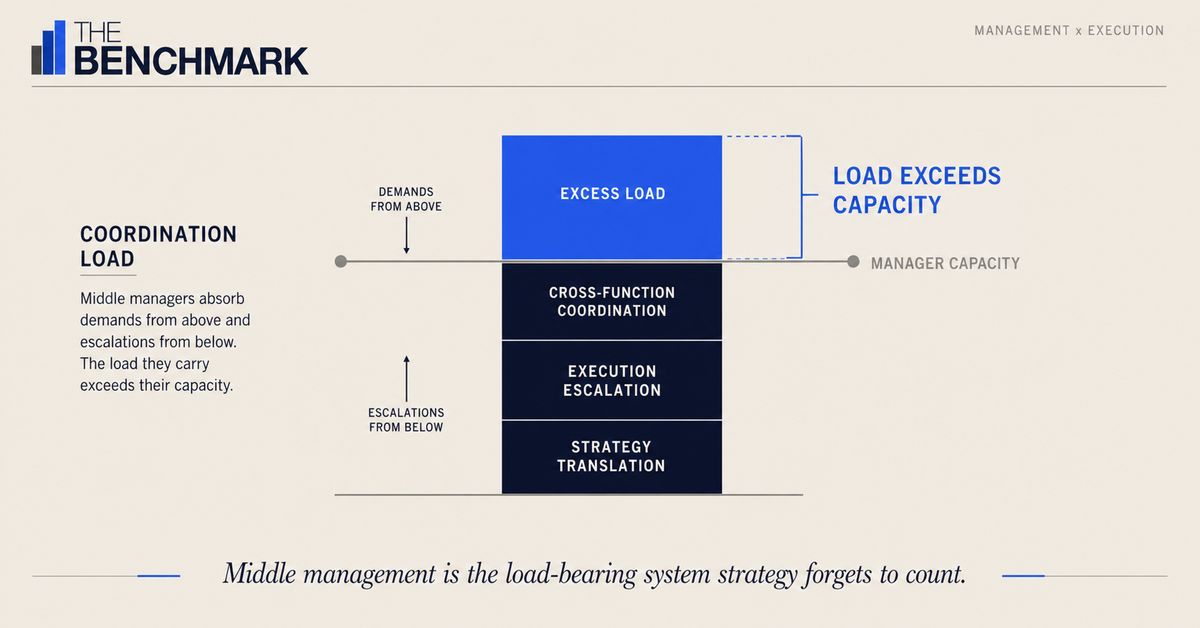
All three had reported to managers who carried more than 16 direct reports, spent nights on approvals, and sat on calendars crowded with status meetings. Those managers were not failing because they lacked resilience. They had no capacity left to coach, translate strategy, resolve tradeoffs, or notice when high performers were drifting.
This is the mistake companies make when they treat middle management as overhead. The layer looks expensive because its work is hard to see on a dashboard. But it is where strategy becomes behavior, where ambiguity gets resolved, and where future leaders learn how the business actually works.
When that layer breaks, the strategy does not break loudly. It stops translating.
Table of Contents
The Disengagement Cascade
Gallup's State of the Global Workplace research shows declines in manager engagement under pressure, which matter because manager engagement is directional. Disengaged managers not only perform worse themselves. They transmit lower clarity, lower energy, and weaker accountability to the teams they lead.
That transmission mechanism is easy to underestimate. Most organizations measure engagement as a sentiment issue. In the manager layer, it is an execution issue.
Managers are the connective tissue between leadership intent and front-line behavior. They translate priorities into weekly choices. They decide which tradeoffs get escalated and which get absorbed. They coach employees through ambiguity. They detect when a high performer is quietly disconnecting. They see where process design is failing before the dashboard does.
When managers lose capacity, those functions degrade. Strategy becomes less precise as it moves down the organization. Ground-level signals become weaker as they move up. Talent problems surface later. Rework increases because teams receive less useful guidance before acting.
The organization still looks managed. It is being managed with fewer and fewer signals.
Administrative Burden Is Where the Leverage Is
Most managers are not unwilling to lead. The role has accumulated work that crowds out management.
McKinsey's Power to the Middle research found that middle managers spend large portions of their time on administrative and individual contributor tasks rather than coaching, talent development, and strategic translation. Deloitte's research on organizational capacity points to the same pattern: companies have loaded managers with coordination work while asking them to increase agility, engagement, and transformation velocity.
This produces a quiet substitution. Managers do less of the work only managers can do because they are busy doing work the system has failed to remove, automate, or redesign.
The visible symptoms are familiar: slow approvals, crowded calendars, weak feedback loops, shallow coaching, inconsistent prioritization, and employees who do not understand how their work connects to strategy. The underlying mechanism is role load.
A manager with fifteen direct reports, three transformation initiatives, a heavy individual contributor workload, and a calendar full of status meetings cannot be the translation layer leadership needs. The math does not work.
Organizations often respond with another training program. Training helps when the role is designed to be performed. It does not solve a role that has become structurally impossible.
Span of Control Is a Strategy Variable
Span of control is usually treated as an HR metric. It should be treated as a strategy variable.
A manager's span determines how much attention each employee receives, how quickly ambiguity is resolved, how effectively performance is coached, and how early talent risk is detected. Wider spans can work in stable, standardized environments with experienced teams and clear work systems. They are much more dangerous in environments with high change, ambiguous priorities, and uneven employee capability.
That distinction matters because many organizations have widened spans while increasing complexity. They flattened the structure, reduced layers, and gave managers more reports. At the same time, they added AI adoption, transformation work, hybrid coordination, and faster planning cycles.
The result is not efficiency. It is compression.
Managers have less time per employee and more complexity per decision. Employees receive less context. Strategy becomes more generic. Local teams fill the gaps themselves. That may work for routine execution. It fails when the company needs judgment, adaptation, and trust.
The cost is not always visible in the first quarter. It appears in slower capability building, weaker succession pipelines, lower engagement, and the loss of high performers who stop believing the organization can support their growth.
The Training Gap Compounds Everything
Training is necessary. It is also insufficient.
Gallup and Harvard Business Impact have both highlighted gaps in manager training and development. Many managers move into the role because they were strong individual contributors, not because they have been prepared to coach, set expectations, resolve conflict, and translate strategy.
That gap matters more now because the manager's role has become harder. Hybrid teams require more deliberate communication. AI changes how work is assigned and reviewed. Younger employees often need more frequent feedback. Senior employees need autonomy without neglect. Transformation programs create ambiguity faster than annual training calendars can absorb.
An undertrained, overloaded manager becomes a bottleneck. Not because the manager is weak, but because the organization has placed too much interpretive burden on one role.
The solution is not to romanticize middle management. Some managers underperform. Some roles should be redesigned out of existence. Some layers are unnecessary. But the current fashion of treating middle management as a cost pool ignores what the layer actually does.
The best companies will not blindly preserve middle management. They will make the layer smaller where it is bureaucratic and stronger where it is strategic.
Where This Argument Gets Complicated
The counterargument is that middle management has often been a source of bureaucracy. That critique is valid.
Some managers make slow decisions, protect turf, poorly translate strategy, or add approval steps that do not improve quality. Flattening can remove real friction. AI can automate coordination work that managers should not have been doing in the first place. The case for redesign is strong.
But redesign is different from extraction.
Cutting layers without redesigning decision rights, workflows, and role expectations does not eliminate management work. It redistributes it. Senior leaders absorb more escalations. Individual contributors carry more coordination. High performers become informal managers without authority. The work does not disappear. It becomes less visible and less accountable.
The better question is not whether the organization has too many managers. It is which management work creates value, which work is administrative waste, and whether the people responsible for the valuable work have the capacity to do it.
Implications for Leaders
Audit the manager role before launching another manager initiative.
Measure direct reports, meeting load, approval volume, individual contributor responsibilities, transformation work, and coaching time. If managers do not have time to manage, training will not solve the problem.
Remove low-judgment administrative work.
Approvals, reporting, status collection, and routine coordination should be redesigned before managers are asked to become better coaches. AI may help here, but only if the work is simplified first.
Treat span of control as context-specific.
There is no universal optimal span. A stable operations team can support a wider span than a team navigating transformation, new technology, or heavy talent development. Span decisions should reflect work complexity, not only cost targets.
Give managers decision rights that match expectations.
Organizations often hold managers accountable for engagement, performance, and prioritization without giving them authority over workload, tradeoffs, or staffing. That mismatch breeds cynicism and weak execution.
Protect coaching and translation time.
The work only managers can do requires time that is not fragmented. If calendars make coaching impossible, the organization has already decided that coaching is optional.
The Bottom Line
Manager burnout is not mainly a wellness problem. It is a design failure in the layer responsible for turning strategy into execution.
Organizations have loaded managers with larger spans, more administration, more transformation work, and fewer support structures, then interpreted the resulting burnout as an individual resilience issue. The data points in the other direction. Team engagement, talent development, priority translation, and strategic coherence all run through the manager. When that layer loses capacity, the company loses more than morale. It loses the operating channel through which strategy becomes daily behavior.
Another generic leadership program layered on top of an impossible role will not fix it. It is role redesign: fewer low-judgment approvals, clearer decision rights, realistic spans of control, and protected time for the work only managers can do. The management layer is not the place to find hidden savings. It is where hidden execution risk is already accumulating.
Sources
Gallup. "State of the Global Workplace." https://www.gallup.com/workplace/349484/state-of-the-global-workplace.aspx
Gallup. "U.S. Employee Engagement Sinks to 10-Year Low." January 2025. https://www.gallup.com/workplace/654911/employee-engagement-sinks-year-low.aspx
Gallup. "The Antidote to Manager Burnout." https://www.gallup.com/workplace/389057/antidote-manager-burnout.aspx
Deloitte. "Reclaiming Organizational Capacity." https://www.deloitte.com/us/en/insights/focus/human-capital-trends/2025/reclaiming-organizational-capacity.html
Deloitte. "The Future of the Middle Manager." https://www.deloitte.com/us/en/insights/focus/human-capital-trends/2025/future-of-the-middle-manager.html
McKinsey & Company. "Power to the Middle, One Year Later." https://www.mckinsey.com/about-us/new-at-mckinsey-blog/power-to-the-middle-one-year-later
McKinsey & Company. "Stop Wasting Your Most Precious Resource: Middle Managers." https://www.mckinsey.com/capabilities/people-and-organizational-performance/our-insights/stop-wasting-your-most-precious-resource-middle-managers
Harvard Business Impact. "The Burnout Risk: Strengthening Your Midlevel Leaders." https://www.harvardbusiness.org/insight/the-burnout-risk-strengthening-your-midlevel-leaders/