Why Clarity Has Become the Binding Constraint on Execution
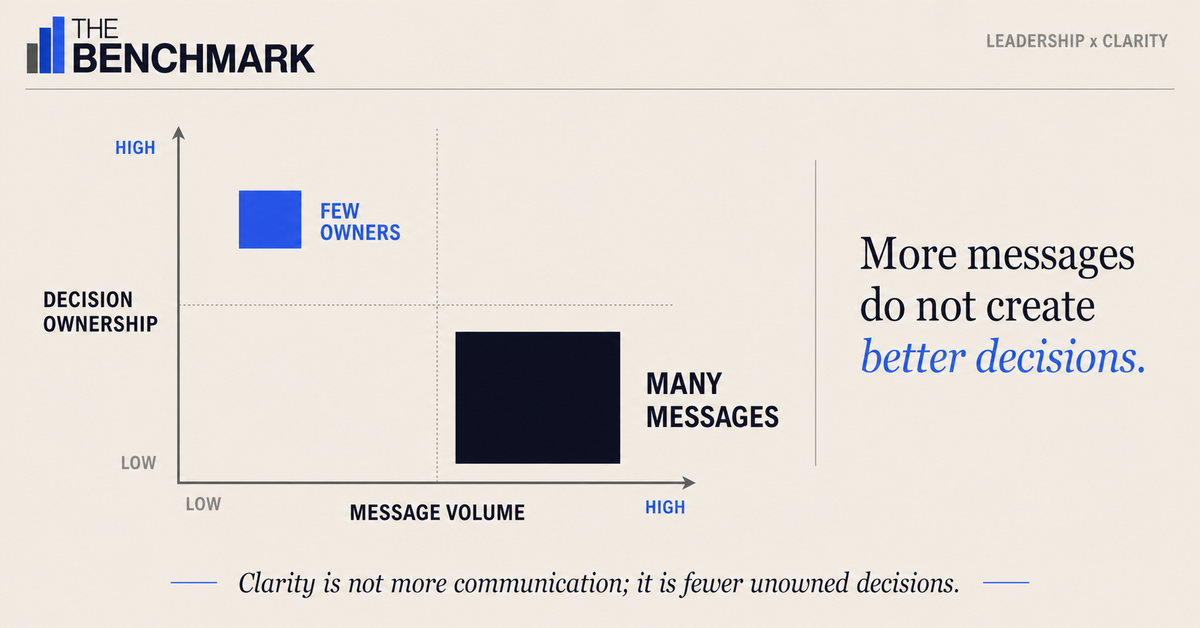
Organizations do not have a communication problem. They have a decision-rights problem pretending to be one.

Three executives leave the same strategy meeting believing they are aligned. Two weeks later, their teams are funding contradictory work, escalating different priorities, and using different definitions of success.
No one misunderstood the slide deck. The failure sat underneath it.
Most organizations have increased communication volume without increasing structural clarity. More meetings, more dashboards, more project tools, more AI-generated summaries. The result is not coherence. It is a louder operating system with the same unresolved questions: who owns the decision, what tradeoff has already been made, what work stops when new work starts, and what success means when functions disagree.
That is why clarity has become the binding constraint on execution. It is not a communication virtue. It is infrastructure: decision rights, priority boundaries, escalation paths, and accountability that survive contact with real work.
Table of Contents
- The Alignment Illusion
- How Clarity Collapses
- Decision Architecture Is the Missing Infrastructur …
- The Manager Layer Cannot Carry This Alone
- Where This Argument Gets Complicated
- Implications for Leaders
- The Bottom Line
- Sources
The Alignment Illusion
Most companies are better at producing alignment artifacts than alignment.
They have annual priorities, quarterly OKRs, operating reviews, dashboards, project plans, all-hands decks, and collaboration platforms. They have more recorded meetings, more written updates, and more tools to summarize the work. The signal appears abundant.
The experience inside the organization is different.
Gallup has found that the share of employees who strongly agree they know what is expected of them at work is shrinking. Employees with clear expectations are far more likely to be engaged, yet expectation clarity has weakened as organizations have added more communication infrastructure.
That is the tell. If more communication were the answer, clarity would improve. It is not.
The problem is that much of what organizations call communication is only broadcast. It distributes information without resolving the structural questions that govern execution. Who decides? Which priority wins? What tradeoff has already been accepted? What work is no longer important? Where does local autonomy end?
Until those questions are answered, employees do not lack messages. They lack operating clarity.
How Clarity Collapses
Clarity collapses when strategy enters the organization without a decision architecture.
A leadership team announces five priorities. Each is defensible. Each has an executive sponsor. Each has metrics. None has a clear rule for what happens when it collides with the others.
Product wants speed. Finance wants margin. Legal wants risk reduction. Sales wants customization. Operations wants stability. Every function can defend its position. The conflict is not irrational. It is ungoverned.
Managers then become the translation layer. They are expected to turn executive intent into team-level tradeoffs while absorbing the contradictions that leadership did not resolve. They explain why the new priority matters, even though they can't stop old work. They manage capacity without control over demand. They ask teams to move faster inside systems that have not made the hard choices.
This is why strategic overload feels like execution failure. The organization is not failing to understand the strategy. It is failing to convert the strategy into a decision hierarchy.
The result is predictable. Teams become busy but directionally inconsistent. High performers spend more time reconciling conflicts. Low performers find cover in ambiguity. Rework rises because people discover too late that they were optimizing for different definitions of success.
Clarity decay is not soft. It is operational drag.
Decision Architecture Is the Missing Infrastructure
Most organizations have invested heavily in collaboration infrastructure and lightly in decision infrastructure.
They know where documents live. They know where meetings happen. They know where projects are tracked. They do not always know who owns a cross-functional decision, what evidence is required, when escalation happens, or which tradeoff has already been settled.
This is the missing layer.
Decision architecture defines the rights, thresholds, criteria, and escalation paths that turn intent into action. It makes explicit what many companies leave to interpretation. It also prevents the most common form of execution drift: local teams making reasonable decisions that conflict with one another because the system never gave them a shared rule.
MIT Sloan Management Review has written about intelligent choice architectures and the way decision rights are being rewritten as AI enters the organization. That matters because AI accelerates local decision-making. When decision rights are unclear, faster choice is not always better. It can produce faster divergence.
The test is not whether teams are communicating. It is whether the organization has defined the decisions that matter enough to be governed.
The Manager Layer Cannot Carry This Alone
Managers are the place where clarity either becomes real or dies.
They translate strategy into priorities. They tell teams what matters this week. They explain tradeoffs. They detect confusion before it becomes rework. They see when the operating model is asking for impossible combinations.
That layer is under structural load.
Gallup's research on span of control shows managers overseeing more people than in prior years. Manager engagement has weakened. Deloitte and McKinsey have both documented the growing administrative and coordination burden placed on middle managers. The same layer expected to restore clarity is losing the capacity to do it.
This creates a dangerous loop. Leaders respond to execution problems by increasing communication, reporting, and transformation work. Managers absorb the additional translation burden. Their capacity falls. Teams receive less useful guidance. Execution drifts. Leaders add still more process.
The manager is not the root cause. The role is where the root cause becomes visible.
Treating clarity as a manager communication problem misdiagnoses the issue. Managers can reinforce clarity. They cannot manufacture it when leadership has not made the underlying decisions.
Where This Argument Gets Complicated
There is a risk in overcorrecting.
Not every decision should be centralized. Not every tradeoff can be pre-defined. Organizations need local judgment, experimentation, and room for teams to adapt to facts senior leaders cannot see. Excessive clarity can become rigidity.
The goal is not to turn the organization into a rules engine. It is to distinguish between the decisions that require a common architecture and the decisions that benefit from local autonomy.
A product team should have room to adjust implementation details. It should not have to guess whether growth, margin, quality, or risk wins when the tradeoff matters. A manager should have room to shape team routines. She should not have to invent priority logic every time two executive initiatives collide.
Clarity is not the elimination of judgment. It is the protection of judgment from ambiguity that should have been resolved earlier.
Implications for Leaders
Audit clarity as a control.
Choose one strategic priority and ask five questions: who owns the decision, what tradeoff has been made, what work stops, what metric wins when functions disagree, and who can resolve conflict within 48 hours. If the answers vary by function, the priority is not clear.
Map decision collisions.
Before adding new initiatives, identify the places where existing priorities collide. Product roadmap versus margin. AI speed versus risk. Customer customization versus operational simplicity. The collisions are where clarity matters most.
Redesign the manager role before adding more communication.
If managers are expected to translate strategy, they need authority, capacity, and fewer low-judgment administrative tasks. Otherwise, the company is asking an overloaded layer to compensate for structural ambiguity.
Build decision architecture into AI governance.
AI will accelerate local decisions. That makes clarity more important, not less. Every AI deployment should include a decision-rights review: who owns the output, who verifies quality, who can stop the workflow, and what happens when the model's recommendation conflicts with human judgment.
Cap initiative load.
A company pursuing too many priorities is choosing ambiguity by default. Senior teams should treat initiative load as a scarce resource. The work that remains unfunded, paused, or stopped is part of the strategy.
The Bottom Line
Execution does not usually fail because people missed the message. It fails because the organization never converted intent into an operating structure.
Clarity is the mechanism that turns strategy into behavior. When decision rights are ambiguous, priorities compete silently. When tradeoffs are unnamed, teams make local optimizations that collide later. When managers are expected to translate everything without authority or capacity, alignment becomes theater.
The organizations that close this gap will not be the ones with better cascade decks. They will be the ones who treat clarity as infrastructure: owned, measured, maintained, and redesigned when complexity changes. Ambiguity is not a soft problem. It is execution debt.
Sources
Gallup. "U.S. Employee Engagement Sinks to 10-Year Low." January 2025. https://www.gallup.com/workplace/654911/employee-engagement-sinks-year-low.aspx
Gallup. "Anemic Employee Engagement Points to Leadership Challenges." August 2025. https://www.gallup.com/workplace/692954/anemic-employee-engagement-points-leadership-challenges.aspx
Gallup. "U.S. Employee Engagement Declines From 2020 Peak." January 2026. https://www.gallup.com/workplace/701486/employee-engagement-declines-2020-peak.aspx
Gallup. "Span of Control: What's the Optimal Team Size for Managers?" January 2026. https://www.gallup.com/workplace/700718/span-control-optimal-team-size-managers.aspx
McKinsey & Company. "Reconfiguring Work: Change Management in the Age of Gen AI." https://www.mckinsey.com/capabilities/quantumblack/our-insights/reconfiguring-work-change-management-in-the-age-of-gen-ai
MIT Sloan Management Review. "The Great Power Shift: How Intelligent Choice Architectures Rewrite Decision Rights." https://sloanreview.mit.edu/article/the-great-power-shift-how-intelligent-choice-architectures-rewrite-decision-rights/